
ABRUZZO
ITALIAABOUT PILOT AREA
Abruzzo, particularly its inland areas, has always been characterized by delays and difficulties in socioeconomic development.
Its particularly mountainous terrain has always made it highly isolated and, particularly in the last century, has been affected by demographic decline and an aging population, which are a source of considerable concern.
Agriculture is only subsistence, with high-quality production, but still very marginal. Industry, developed during the economic boom of the 1950s and 1960s, has not been adequately prepared for the challenges of globalization and digitalization, and has been in serious crisis for decades.
In the service sector, tourism is playing a growing role, often driven by environmental sustainability and respect for the local environment. This is undeniable in a region known as the green heart of Europe for its three national parks, a regional park, and several nature reserves. However, the challenge is to continue driving tourism development while engaging local communities.
Abruzzo, due to its mountainous terrain, has always been considered a marginal region. However, in recent years, the region has experienced significant change thanks to a profound push for social innovation emanating from its inland areas, as well as the development of sustainable tourism.
Examples of this include the flourishing of energy communities (Gagliano Aterno), digital welfare initiatives (Calascio), and community-based cooperatives in general (Campo di Giove, Aielli, Popoli, Tufillo, Navelli).
The Abruzzo Region itself has begun to incorporate this profound drive into its own policies, addressing local needs with a particular focus on health and well-being for all and of all ages, inclusive and sustainable economic growth, equal opportunities, and digitalization. These goals have so far been only partially achieved, but the network of Community Cooperatives proposed by Borghi IN seeks to give new impetus and, above all, new value to these initiatives through networking.
ABOUT VULNERABLE GROUPS OF THE PILOT AREA
Due to its morphological characteristics, inland Abruzzo faces problems and challenges related to isolation, lack of services, and an aging population.
The most prevalent vulnerable groups (women, young people, the elderly, and disabled people), despite not having specific problems, suffer exponentially. In recent years, immigrants have joined them, a group that overlaps with the aforementioned categories, creating even more marked disparities, such as in the case of migrant women, who are particularly at risk of isolation.
The network of Community Cooperatives seeks to provide solutions to these vulnerable groups, leaving no one behind.
NOTIZIE/OUTCOMES
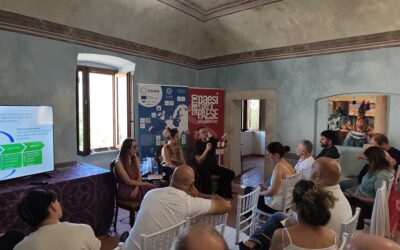
ESIRA presentato al Community-based Cooperatives Festival in Abruzzo
Dal 4 al 6 settembre 2026, Borghi IN Rete ha organizzato il Community-based Cooperatives Festival in Abruzzo, in Italia, riunendo cooperative di comunità, comunità locali, istituzioni, organizzazioni e ricercatori impegnati a rafforzare la vitalità sociale ed...

IL PROGETTO ESIRA HA ORGANIZZATO UN WORKSHOP DI DISSEMINAZIONE SCIENTIFICA E UNA SESSIONE DELLA COMMUNITY OF PRACTICE SULL’INNOVAZIONE RURALE
Il progetto ESIRA ha organizzato con successo il suo workshop finale di disseminazione scientifica per quest’anno, intitolato “From Collaboration to Action: How Multi-Actor Platforms Shape Rural Innovation”, seguito da una sessione della Community of Practice (CoP)...

SEGNA LA DATA E INVITO ALLA PARTECIPAZIONE: WORKSHOP DI DISSEMINAZIONE SCIENTIFICA ESIRA E SESSIONE DELLA COMUNITÀ DI PRATICA (CoP)
Il progetto ESIRA è lieto di annunciare il prossimo Workshop di Disseminazione Scientifica e Sessione della Comunità di Pratica (CoP), che si terrà il 17 dicembre 2025 alle ore 10:00 CET, online su MS Teams. Con il titolo “Dalla collaborazione all’azione: come le...

L’INNOVAZIONE RURALE AL CENTRO DELLA 10ª CONFERENZA EMES CON UN PANEL SULL’ECONOMIA SOCIALE RURALE
Un team di ricercatori dei progetti Horizon Europe ESIRA e SERIGO ha presentato i propri risultati alla 10ª conferenza EMES. Coordinato da Luca Koltai (HÉTFA Research Institute), il panel ha visto i contributi di studiosi dell’Università di Burgos, Euricse, della...

GIORNATE ESIRA AL FESTIVAL DELL’ABRUZZO: SIAMO BORGHI PER IL PAESE
A Fresagrandinaria, Tufillo e San Giovanni Lipioni, tre giorni di dialogo e visione condivisa. Il focus su ESIRA e il dialogo con la Regione aprono la strada alla revisione della Legge 25/2015. Tre giorni per connettersi, coinvolgersi e costruire visioni comuni....

LA QUARTA ASSEMBLEA GENERALE SI È TENUTA IN POLONIA
La quarta Assemblea Generale del progetto ESIRA (Enhancing Social Inclusion and Rural Areas) si è svolta dal 15 al 17 ottobre 2025 a Orelec, nei Monti Bieszczady, in Polonia. L’evento è stato ospitato dal partner locale, l’European Rural Development Network (ERDN), e...

LA TERZA ASSEMBLEA GENERALE DEL PROGETTO ESIRA SI È TENUTA IN NORVEGIA
La terza Assemblea Generale del progetto ESIRA (Enhancing Social Inclusion and Rural Areas) si è svolta dal 20 al 22 maggio 2025 nella città norvegese di Kongsvinger. L’evento è stato ospitato dai partner locali, l’Inland Norway University of Applied Sciences (INN) e...
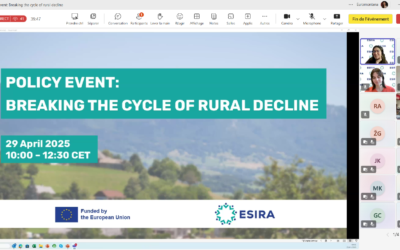
INTERROMPERE IL CICLO DEL DECLINO DELLE AREE RURALI: ESIRA ORGANIZZA IL SUO PRIMO WORKSHOP DI POLICY
Come possiamo invertire il ciclo del declino delle aree rurali? Come possono gli attori dell’economia sociale diventare parte della soluzione? Queste sono state le domande centrali affrontate oggi, 29 aprile 2025, durante il primo workshop di policy del progetto...

RAPPORTO REGIONALE: ABRUZZO E TRENTINO, ITALIA
L’obiettivo principale di questo rapporto è stato raccogliere informazioni sulla situazione delle aree rurali e delle comunità residenti in ciascuna delle regioni partecipanti al progetto ESIRA. Questi rapporti costituiranno la base per lo “Studio comparativo...

SAVE THE DATE! INTERROMPERE IL CICLO DEL DECLINO DELLE AREE RURALI: EVENTO DI POLICY ESIRA IL 29 APRILE 2025
Le comunità rurali di tutta l’Unione europea si trovano ad affrontare un ciclo di declino che tende ad autoalimentarsi. La mancanza di posti di lavoro e il ridotto accesso a servizi essenziali, come l’assistenza sanitaria e l’istruzione, favoriscono lo spopolamento,...