
ABRUZZO
WŁOCHYABOUT PILOT AREA
Abruzzo, particularly its inland areas, has always been characterized by delays and difficulties in socioeconomic development.
Its particularly mountainous terrain has always made it highly isolated and, particularly in the last century, has been affected by demographic decline and an aging population, which are a source of considerable concern.
Agriculture is only subsistence, with high-quality production, but still very marginal. Industry, developed during the economic boom of the 1950s and 1960s, has not been adequately prepared for the challenges of globalization and digitalization, and has been in serious crisis for decades.
In the service sector, tourism is playing a growing role, often driven by environmental sustainability and respect for the local environment. This is undeniable in a region known as the green heart of Europe for its three national parks, a regional park, and several nature reserves. However, the challenge is to continue driving tourism development while engaging local communities.
Abruzzo, due to its mountainous terrain, has always been considered a marginal region. However, in recent years, the region has experienced significant change thanks to a profound push for social innovation emanating from its inland areas, as well as the development of sustainable tourism.
Examples of this include the flourishing of energy communities (Gagliano Aterno), digital welfare initiatives (Calascio), and community-based cooperatives in general (Campo di Giove, Aielli, Popoli, Tufillo, Navelli).
The Abruzzo Region itself has begun to incorporate this profound drive into its own policies, addressing local needs with a particular focus on health and well-being for all and of all ages, inclusive and sustainable economic growth, equal opportunities, and digitalization. These goals have so far been only partially achieved, but the network of Community Cooperatives proposed by Borghi IN seeks to give new impetus and, above all, new value to these initiatives through networking.
ABOUT VULNERABLE GROUPS OF THE PILOT AREA
Due to its morphological characteristics, inland Abruzzo faces problems and challenges related to isolation, lack of services, and an aging population.
The most prevalent vulnerable groups (women, young people, the elderly, and disabled people), despite not having specific problems, suffer exponentially. In recent years, immigrants have joined them, a group that overlaps with the aforementioned categories, creating even more marked disparities, such as in the case of migrant women, who are particularly at risk of isolation.
The network of Community Cooperatives seeks to provide solutions to these vulnerable groups, leaving no one behind.
AKTUALNOŚCI / WYNIKI

THE FOURTH GENERAL ASSEMBLY WAS HELAD IN POLAND
The fourth General Assembly of the ESIRA project (Enhancing Social Inclusion and Rural Areas) took place from October 15 to 17, 2025, in Orelec, in the Bieszczady Mountains, Poland. The event was hosted by the local partner, the European Rural Development Network...

THIRD GENERAL ASSEMBLY OF THE ESIRA PROJECT HELD IN NORWAY
The third General Assembly of the ESIRA project (Enhancing Social Inclusion and Rural Areas) took place from May 20 to 22, 2025, in the Norwegian town of Kongsvinger. The event was hosted by local partners the Inland Norway University of Applied Sciences (INN), and...
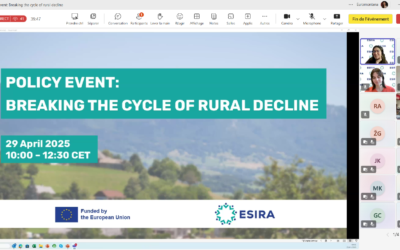
BREAKING THE CYCLE OF RURAL DECLINE: ESIRA LAUNCHES ITS FIRST POLICY WORKSHOP
How can we reverse the cycle of rural decline? How can social economy actors be part of the solution? These were the central questions explored today, 29th of April 2025, during the first policy workshop of the ESIRA project, titled “Breaking the cycle of rural...

REGIONAL REPORT: ABRUZZO & TRENTINO, ITALY
This report presents the preliminary findings of the analysis conducted under T4.1 “Comparative study on social exclusion in rural areas” and T4.2 “Appraisal of existing policies, services and initiatives to support social inclusion and social economy in rural areas”...

SAVE THE DATE! BREAKING THE CYCLE OF RURAL DECLINE: ESIRA POLICY EVENT ON 29TH APRIL 2025
Rural communities across the European Union face a self-reinforcing cycle of decline. The lack of jobs and reduced access to essential services, such as healthcare and education, drive outmigration, particularly among young people. This, in turn, weakens local...

REGISTER FOR THE THIRTEENTH EUROPEAN MOUNTAIN CONVENTION
XIII European Mountain Convention “Shaping the future of mountain economies” | From 15 to 18 October 2024 in Puigcerdà (Catalonia) Mountain economies are based on economic sectors that are the beating heart of mountain areas, provide employment to mountain communities...
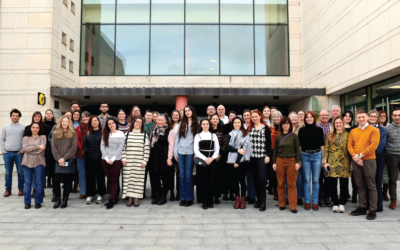
THE KICK-OFF MEETING OF THE ESIRA PROJECT WAS HELD IN BURGOS
A consortium of 15 partners from 8 countries launched the ESIRA Project with the main goal of improving the socio-economic position of the population in rural areas! Partners attended the Kick-off meeting held on January 17th and 18th in Burgos, Spain. The meeting was...
ROZPOCZĘLIŚMY PROJEKT ESIRA
W całej Unii Europejskiej regiony wiejskie, górskie i oddalone obejmują prawie 80% terytorium, ale zamieszkuje je tylko 57% ludności. Pomimo pozornie niewielkiej gęstości zaludnienia, obszary te mają znaczny wpływ na gospodarkę, wnosząc 46% całkowitej wartości dodanej...