
leski-bieszczadzki
POLSKAABOUT PILOT AREA
The pilot area is located in the Podkarpackie Voivodeship in a mountainous area covering two districts: Leski and Bieszczadzki. The area is large in size, but at the same time one of the least populated areas in Poland. It is located on the border with Ukraine and Slovakia, covering the Bieszczady and Sanocko-Turczańskie Mountains. The inhabitants of this region face exclusion on many levels, including access to services, job opportunities, and educational opportunities. For some children, secondary schools are located about 50-60 km from their place of residence, there is a lack of nurseries and kindergartens. Many people work in the tourism industry, which is characterized by seasonality and the presence of tourists.
The pilot area has one of the highest unemployment rates in Poland, young people are flying away, but on the other hand, it has social potential. Research reveals that it has the highest saturation of nonprofit organizations per 10,000 inhabitants, which shows that where many things are lacking, residents take matters into their own hands and start grassroots activities.
ABOUT VULNERABLE GROUPS OF THE PILOT AREA
Several vulnerable groups have been identified in Leski-Bieszczadzki area:
1. Women – living in remote mountainous rural areas, far from many educational and employment opportunities, lack of support in caring for children and the elderly, and household responsibilities resting on their shoulders are factors that cause the exclusion of women in particular from the labor market and financial security.
2. Elderly people – excluded largely in terms of transport, but also economically. There is lack of access to services, including health and care services, and lower digital skills contribute to seniors being a group in need of support.
3. Young people – living in peripheral areas means a limited educational and first job opportunities, a lack of entertainment, no opportunities for development. Some youths leave their family homes after completing primary school at the age of 14-15 and begin living in boarding schools, then move to other places, and some of them never return.
4. Persons with disabilities – Disability is still a taboo subject, it is almost invisible in the public space. Exclusion consists of a lack of appropriate day care places, but also 24-hour care, a lack of appropriate activities, a lack of infrastructure and a systemic lack of support. The biggest problem is with people who are entering adulthood – there are no prospects for them, no job opportunities, no inclusion in various activities, no Professional Activity Facility.
AKTUALNOŚCI / WYNIKI

THE FOURTH GENERAL ASSEMBLY WAS HELAD IN POLAND
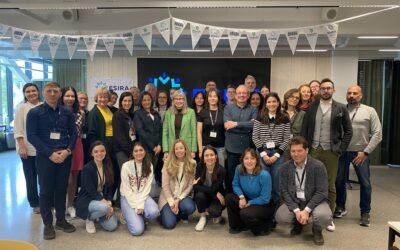
The fourth General Assembly of the ESIRA project (Enhancing Social Inclusion and Rural Areas) took place from October 15 to 17, 2025, in Orelec, in the Bieszczady Mountains, Poland. The event was hosted by the local partner, the European Rural Development Network...
THIRD GENERAL ASSEMBLY OF THE ESIRA PROJECT HELD IN NORWAY
The third General Assembly of the ESIRA project (Enhancing Social Inclusion and Rural Areas) took place from May 20 to 22, 2025, in the Norwegian town of Kongsvinger. The event was hosted by local partners the Inland Norway University of Applied Sciences (INN), and...
BREAKING THE CYCLE OF RURAL DECLINE: ESIRA LAUNCHES ITS FIRST POLICY WORKSHOP
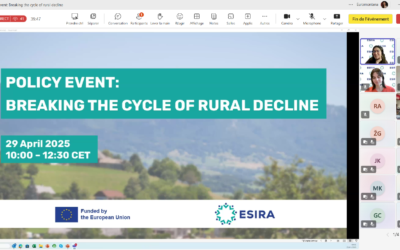
How can we reverse the cycle of rural decline? How can social economy actors be part of the solution? These were the central questions explored today, 29th of April 2025, during the first policy workshop of the ESIRA project, titled “Breaking the cycle of rural...

REGIONAL REPORT: ZAPADNOPOMORSKIE & LESKI-BIESZCZADZKI, POLAND
The main aim of this report was to collect information regarding the situation of rural areas and the communities residing in each of the participating regions in the ESIRA project (ENHANCING SOCIAL INNOVATION IN RURAL AREAS HORIZON 101136253). These reports will act...

SAVE THE DATE! BREAKING THE CYCLE OF RURAL DECLINE: ESIRA POLICY EVENT ON 29TH APRIL 2025
Rural communities across the European Union face a self-reinforcing cycle of decline. The lack of jobs and reduced access to essential services, such as healthcare and education, drive outmigration, particularly among young people. This, in turn, weakens local...

REGISTER FOR THE THIRTEENTH EUROPEAN MOUNTAIN CONVENTION
XIII European Mountain Convention “Shaping the future of mountain economies” | From 15 to 18 October 2024 in Puigcerdà (Catalonia) Mountain economies are based on economic sectors that are the beating heart of mountain areas, provide employment to mountain communities...
ERDN HAS ORGANIZED THE FIRST KICK-OFF MEETING IN THE LESKI AND BIESZCZADY POVIATS
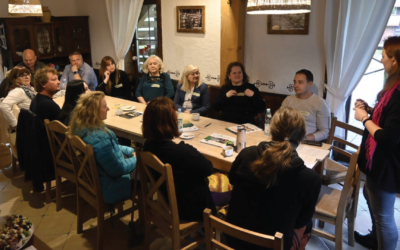
On April 17th, the activities of the multi-actor platform MAP Leski-Bieszczadzki in Poland were initiated during the Polish kick-off meeting of the ESIRA Project. ERDN (European Rural Development Network), as one of the project partners, is tasked with establishing...
THE KICK-OFF MEETING OF THE ESIRA PROJECT WAS HELD IN BURGOS
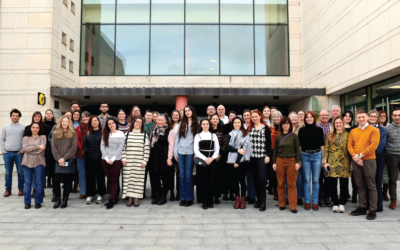
A consortium of 15 partners from 8 countries launched the ESIRA Project with the main goal of improving the socio-economic position of the population in rural areas! Partners attended the Kick-off meeting held on January 17th and 18th in Burgos, Spain. The meeting was...
ROZPOCZĘLIŚMY PROJEKT ESIRA
W całej Unii Europejskiej regiony wiejskie, górskie i oddalone obejmują prawie 80% terytorium, ale zamieszkuje je tylko 57% ludności. Pomimo pozornie niewielkiej gęstości zaludnienia, obszary te mają znaczny wpływ na gospodarkę, wnosząc 46% całkowitej wartości dodanej...