
innlandet
NORWEGIAABOUT PILOT AREA
The Kongsvinger region is situated in southern part of Innlandet county, close to the Swedish border, the region consists of six municipalities: Kongsvinger, Eidskog, Sør‑Odal, Nord‑Odal, Grue and Åsnes, with Kongsvinger town as the central hub for services and employment.
The landscape is dominated by forests, cultivated land and the Glomma river, and includes Finnskogen, historically linked to Forest Finn migration and today recognised as part of Norway’s national minority heritage. The region has a population of around 49,000 with an ageing demographic the region is experiencing increased pressure on welfare services.
The Kongsvinger region in Innlandet county faces a range of social and demographic challenges that require strategic planning and inclusive solutions. Some areas are experiencing population decline; others have a challenging demography with a higher percentage of residents above the age of 67 than in the 0-19 age range. Domestic migration contributes to depopulation, and limited access to services and infrastructure further reinforces social exclusion.
At the same time, evolving social and technological trends are reshaping traditional rural lifestyles and community structures. The region has active civil society organizations, especially those representing people with disabilities, but these groups often face barriers to participation in local development processes. Despite challenges, the region offers strong foundations for community-led inclusion. A vibrant voluntary sector provides social arenas, and Innlandet’s Regional Plan for the Inclusive Innlandet prioritises competence, lifelong learning, and inclusive working life. Local social‑economy initiatives such as Eskoleia (Kongsvinger) and Vekstbedriften Vilja (Eidskog) demonstrate how industrial traditions can be mobilised for social goals, combining production with tailored training and follow‑up to help individuals overcome barriers to employment
ABOUT VULNERABLE GROUPS OF THE PILOT AREA
ESIRA’s work in Kongsvinger focuses primarily on people with disabilities, who face barriers due to limited universal design in physical spaces and communication. Inadequate accessibility can lead to “double exclusion,” and there is a clear need for inclusive environments for the different types of disabilities.
Other vulnerabilities intersect with these challenges, including young adults struggling with education or work, older residents at risk of isolation, and immigrants who encounter language barriers. These factors combine to create complex patterns of social exclusion in rural communities. While the primary target groups is people with disabilities the initiatives developed by the Kongsvinger MAP will provide potential benefits for many other people who find themselves in vulnerable situations.
AKTUALNOŚCI / WYNIKI

THE FOURTH GENERAL ASSEMBLY WAS HELAD IN POLAND
The fourth General Assembly of the ESIRA project (Enhancing Social Inclusion and Rural Areas) took place from October 15 to 17, 2025, in Orelec, in the Bieszczady Mountains, Poland. The event was hosted by the local partner, the European Rural Development Network...
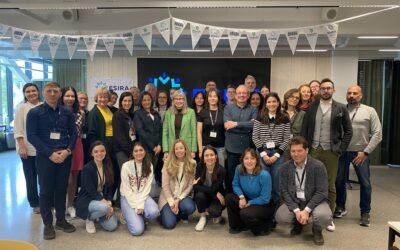
THIRD GENERAL ASSEMBLY OF THE ESIRA PROJECT HELD IN NORWAY
The third General Assembly of the ESIRA project (Enhancing Social Inclusion and Rural Areas) took place from May 20 to 22, 2025, in the Norwegian town of Kongsvinger. The event was hosted by local partners the Inland Norway University of Applied Sciences (INN), and...
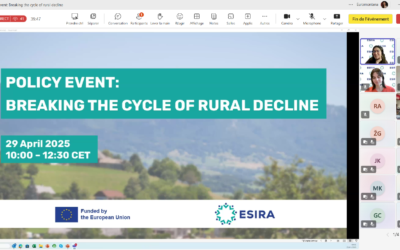
BREAKING THE CYCLE OF RURAL DECLINE: ESIRA LAUNCHES ITS FIRST POLICY WORKSHOP
How can we reverse the cycle of rural decline? How can social economy actors be part of the solution? These were the central questions explored today, 29th of April 2025, during the first policy workshop of the ESIRA project, titled “Breaking the cycle of rural...

REGIONAL REPORT: INNLANDET, NORWAY
The main aim of this report has been to collect information regarding the situation of rural areas and the communities residing in each of the participating regions in the ESIRA project (ENHANCING SOCIAL INNOVATION IN RURAL AREAS HORIZON 101136253). These reports will...

SAVE THE DATE! BREAKING THE CYCLE OF RURAL DECLINE: ESIRA POLICY EVENT ON 29TH APRIL 2025
Rural communities across the European Union face a self-reinforcing cycle of decline. The lack of jobs and reduced access to essential services, such as healthcare and education, drive outmigration, particularly among young people. This, in turn, weakens local...

REGISTER FOR THE THIRTEENTH EUROPEAN MOUNTAIN CONVENTION
XIII European Mountain Convention “Shaping the future of mountain economies” | From 15 to 18 October 2024 in Puigcerdà (Catalonia) Mountain economies are based on economic sectors that are the beating heart of mountain areas, provide employment to mountain communities...
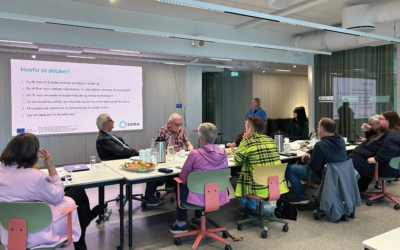
AN INFORMATIVE MEETING WAS SUCCESSFULLY HELD IN EАSTERN NORWAY
In early May, the Norwegian ESIRA project group hosted an information night focused on the inclusion of people with disabilities in the Kongsvinger region of Inland county, located in eastern Norway. At this informational meeting, attendees included participants from...
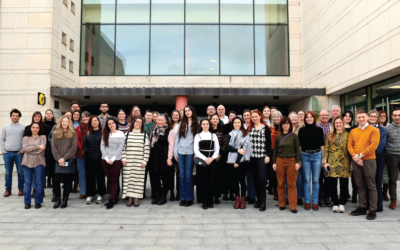
THE KICK-OFF MEETING OF THE ESIRA PROJECT WAS HELD IN BURGOS
A consortium of 15 partners from 8 countries launched the ESIRA Project with the main goal of improving the socio-economic position of the population in rural areas! Partners attended the Kick-off meeting held on January 17th and 18th in Burgos, Spain. The meeting was...
ROZPOCZĘLIŚMY PROJEKT ESIRA
W całej Unii Europejskiej regiony wiejskie, górskie i oddalone obejmują prawie 80% terytorium, ale zamieszkuje je tylko 57% ludności. Pomimo pozornie niewielkiej gęstości zaludnienia, obszary te mają znaczny wpływ na gospodarkę, wnosząc 46% całkowitej wartości dodanej...