
northern great plain and cigánd district
WĘGRYABOUT PILOT AREA
The Cigánd district is located in Hungary, in the North Great Plain region, in Borsod-Abaúj-Zemplén country. It is situated in an extremely isolated location, directly next to the Slovak border, including 15 settlements. It is one of the most disadvantaged areas in the country. Agriculture is one of the main economic activities in the area. Unemployment is a major problem, nearly one in four people are unemployed, and also, there is a shortage of skilled labour. Early education is not available due to the shortage of places, primary schools are not available in all settlements, and there’sno high school in the district. Public transportation and road networks are very poor, and the underdevelopment of infrastructure exacerbates the isolation of the region and increases the vulnerability of its residents.
W regionie brakuje wspólnych ram prawnych dla wspierania przedsiębiorstw ekonomii społecznej, a wsparcie opiera się w większym stopniu na funduszach gminnych. Ważne inicjatywy obejmują programy wspierające przedsiębiorstwa społeczne i gminne spółdzielnie socjalne. Priorytety obejmują wspieranie warsztatów rzemieślniczych i promowanie zrównoważonego rolnictwa lokalnego.
ABOUT VULNERABLE GROUPS OF THE PILOT AREA
The two vulnerable age groups in Cigánd district are children and the elderly, while the largest minority ethnic group is the Roma population. In Hungary 77% of Roma people are at risk of poverty which in the pilot areas pairs with spatial segregation as well. The share of people living in severe material and social deprivation or at-risk-of-poverty is almost twice the national average, and child poverty is a serious problem. Many children struggle with learning and behavioural problems due to their disadvantaged backgrounds. In a number of settlements, the rate of disadvantaged children in primary schools is extensively growing and even reaches 90%. The population of the district is less educated and often lack crucial labour-market competences, thus the share of unemployed and inactive persons is high. Public employment and the municipality-focused social economy has major role in tackling structural unemployment.
AKTUALNOŚCI / WYNIKI

THE FOURTH GENERAL ASSEMBLY WAS HELAD IN POLAND
The fourth General Assembly of the ESIRA project (Enhancing Social Inclusion and Rural Areas) took place from October 15 to 17, 2025, in Orelec, in the Bieszczady Mountains, Poland. The event was hosted by the local partner, the European Rural Development Network...

THIRD GENERAL ASSEMBLY OF THE ESIRA PROJECT HELD IN NORWAY
The third General Assembly of the ESIRA project (Enhancing Social Inclusion and Rural Areas) took place from May 20 to 22, 2025, in the Norwegian town of Kongsvinger. The event was hosted by local partners the Inland Norway University of Applied Sciences (INN), and...

BREAKING THE CYCLE OF RURAL DECLINE: ESIRA LAUNCHES ITS FIRST POLICY WORKSHOP
How can we reverse the cycle of rural decline? How can social economy actors be part of the solution? These were the central questions explored today, 29th of April 2025, during the first policy workshop of the ESIRA project, titled “Breaking the cycle of rural...
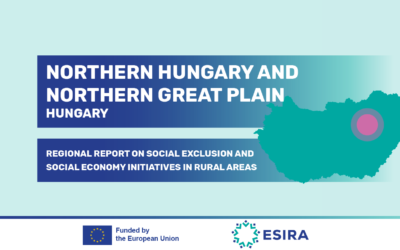
REGIONAL REPORT: NORTHERN HUNGARY AND NORTHERN GREAT PLAIN, HUNGARY
The main aim of this report was to collect information regarding the situation of rural areas and the communities residing in each of the participating regions in the ESIRA project (ENHANCING SOCIAL INNOVATION IN RURAL AREAS HORIZON 101136253). These reports will act...

SAVE THE DATE! BREAKING THE CYCLE OF RURAL DECLINE: ESIRA POLICY EVENT ON 29TH APRIL 2025
Rural communities across the European Union face a self-reinforcing cycle of decline. The lack of jobs and reduced access to essential services, such as healthcare and education, drive outmigration, particularly among young people. This, in turn, weakens local...

REGISTER FOR THE THIRTEENTH EUROPEAN MOUNTAIN CONVENTION
XIII European Mountain Convention “Shaping the future of mountain economies” | From 15 to 18 October 2024 in Puigcerdà (Catalonia) Mountain economies are based on economic sectors that are the beating heart of mountain areas, provide employment to mountain communities...
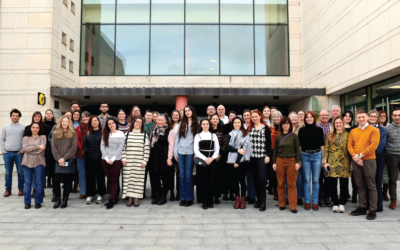
THE KICK-OFF MEETING OF THE ESIRA PROJECT WAS HELD IN BURGOS
A consortium of 15 partners from 8 countries launched the ESIRA Project with the main goal of improving the socio-economic position of the population in rural areas! Partners attended the Kick-off meeting held on January 17th and 18th in Burgos, Spain. The meeting was...
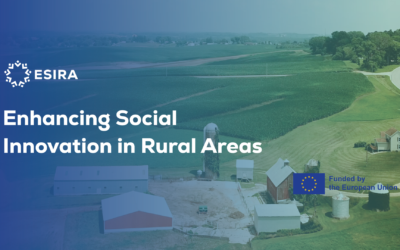
ROZPOCZĘLIŚMY PROJEKT ESIRA
W całej Unii Europejskiej regiony wiejskie, górskie i oddalone obejmują prawie 80% terytorium, ale zamieszkuje je tylko 57% ludności. Pomimo pozornie niewielkiej gęstości zaludnienia, obszary te mają znaczny wpływ na gospodarkę, wnosząc 46% całkowitej wartości dodanej...