
innlandet
NorwayABOUT PILOT AREA
The Kongsvinger region is situated in southern part of Innlandet county, close to the Swedish border, the region consists of six municipalities: Kongsvinger, Eidskog, Sør‑Odal, Nord‑Odal, Grue and Åsnes, with Kongsvinger town as the central hub for services and employment.
The landscape is dominated by forests, cultivated land and the Glomma river, and includes Finnskogen, historically linked to Forest Finn migration and today recognised as part of Norway’s national minority heritage. The region has a population of around 49,000 with an ageing demographic the region is experiencing increased pressure on welfare services.
The Kongsvinger region in Innlandet county faces a range of social and demographic challenges that require strategic planning and inclusive solutions. Some areas are experiencing population decline; others have a challenging demography with a higher percentage of residents above the age of 67 than in the 0-19 age range. Domestic migration contributes to depopulation, and limited access to services and infrastructure further reinforces social exclusion.
At the same time, evolving social and technological trends are reshaping traditional rural lifestyles and community structures. The region has active civil society organizations, especially those representing people with disabilities, but these groups often face barriers to participation in local development processes. Despite challenges, the region offers strong foundations for community-led inclusion. A vibrant voluntary sector provides social arenas, and Innlandet’s Regional Plan for the Inclusive Innlandet prioritises competence, lifelong learning, and inclusive working life. Local social‑economy initiatives such as Eskoleia (Kongsvinger) and Vekstbedriften Vilja (Eidskog) demonstrate how industrial traditions can be mobilised for social goals, combining production with tailored training and follow‑up to help individuals overcome barriers to employment
ABOUT VULNERABLE GROUPS OF THE PILOT AREA
ESIRA’s work in Kongsvinger focuses primarily on people with disabilities, who face barriers due to limited universal design in physical spaces and communication. Inadequate accessibility can lead to “double exclusion,” and there is a clear need for inclusive environments for the different types of disabilities.
Other vulnerabilities intersect with these challenges, including young adults struggling with education or work, older residents at risk of isolation, and immigrants who encounter language barriers. These factors combine to create complex patterns of social exclusion in rural communities. While the primary target groups is people with disabilities the initiatives developed by the Kongsvinger MAP will provide potential benefits for many other people who find themselves in vulnerable situations.
NEWS/OUTCOMES
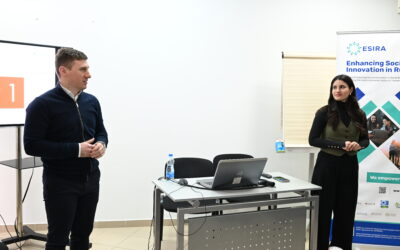
INITIATIVE TO SUPPORT WOMEN-LED RURAL BUSINESSES LAUNCHED IN LESKOVAC
An initiative aimed at strengthening small women-led businesses from rural areas was launched on 18 February 2026 in Leskovac. The event was organized by the Institute for Development and Innovation (IRI), together with the Center for Development of Jablanica and...

NORWEGIAN ESIRA WEBINAR SPOTLIGHTS INNOVATION AND INCLUSION IN KONGSVINGER REGION
How can innovation foster greater inclusion in the Kongsvinger region? That was the central question at a recent webinar organised by the Norwegian project group of ESIRA as part of a regional dissemination workshop. The online morning meeting was attended by 28...

STRENGTHENING THE SOCIAL ECONOMY IN REGIONS: DRUSKININKAI RURAL AREA
On December 8–9, 2025, the Institute of Economics and Rural Development of the Lithuanian Center for Social Sciences, together with the Druskininkai Local Action Group, organized a two-day ESIRA project working meeting. The event brought together representatives of...

ESIRA PROJECT HELD SCIENTIFIC DISSEMINATION WORKSHOP AND COMMUNITY OF PRACTICE SESSION ON RURAL INNOVATION
The ESIRA project successfully organized its final Scientific Dissemination Workshop for this year, titled “From Collaboration to Action: How Multi-Actor Platforms Shape Rural Innovation”, followed by a Community of Practice (CoP) session entitled “Lessons Learned and...

ESIRA AND SERIGO CALL FOR A MORE HOLISTIC VISION TO RURAL POLICY PLANNING
20 November 2025. ESIRA and SERIGO projects organised a joint policy workshop held on 20 November 2025 in Brussels, to explore how community-led social innovation can enhance the social inclusion of vulnerable groups in rural areas. Co-organised by the European...

SAVE THE DATE AND CALL FOR PARTICIPATION: ESIRA Scientific Dissemination Workshop and CoP Session
The ESIRA project is pleased to announce the upcoming Scientific Dissemination Workshop & Community of Practice (CoP) Session, taking place on 17 December 2025 at 10:00 CET, online on MS Teams. Under the title “From Collaboration to Action: How Multi-Actor...

RURAL INNOVATION TAKES CENTRE STAGE AT 10TH EMES CONFERENCE WITH A PANEL ON RURAL SOCIAL ECONOMY
A team of researchers from the ESIRA and SERIGO Horizon Europe projects presented their findings at the 10th EMES conference. Coordinated by Luca Koltai (HÉTFA Research Institute), the panel featured contributions from scholars at the University of Burgos, Euricse,...

THE FOURTH GENERAL ASSEMBLY WAS HELAD IN POLAND
The fourth General Assembly of the ESIRA project (Enhancing Social Inclusion and Rural Areas) took place from October 15 to 17, 2025, in Orelec, in the Bieszczady Mountains, Poland. The event was hosted by the local partner, the European Rural Development Network...

ACCESSIBLE CINEMA EVENT IN CILLERUELO DE ABAJO PROMOTES SOCIAL INCLUSION IN RURAL AREAS
Last weekend, the village of Cilleruelo de Abajo, in the province of Burgos, held a very special event dedicated to accessible cinema. The initiative was organized by the Collalba Cultural Association, in collaboration with ARANSBUR (Association of Families of Deaf...

EL HUECO AND EL COLLETERO SHOWCASES FOR RURAL SOCIAL INNOVATION UNDER ESIRA PROJECT
As part of the training activities carried out by the European ESIRA Project, focused on promoting social innovation in rural areas, on Friday, September 12, nearly 50 rural development practitioners took part in an intensive workday aimed at identifying and learning...