
northern great plain and cigánd district
HungaryABOUT PILOT AREA
The Cigánd district is located in Hungary, in the North Great Plain region, in Borsod-Abaúj-Zemplén country. It is situated in an extremely isolated location, directly next to the Slovak border, including 15 settlements. It is one of the most disadvantaged areas in the country. Agriculture is one of the main economic activities in the area. Unemployment is a major problem, nearly one in four people are unemployed, and also, there is a shortage of skilled labour. Early education is not available due to the shortage of places, primary schools are not available in all settlements, and there’sno high school in the district. Public transportation and road networks are very poor, and the underdevelopment of infrastructure exacerbates the isolation of the region and increases the vulnerability of its residents.
The region lacks a common legal framework for supporting social economy enterprises, with support relying more on municipal funds. Important initiatives include programs supporting social enterprises and rural municipality-based social cooperatives. Priorities include fostering artisan workshops and promoting sustainable local agriculture.
ABOUT VULNERABLE GROUPS OF THE PILOT AREA
The two vulnerable age groups in Cigánd district are children and the elderly, while the largest minority ethnic group is the Roma population. In Hungary 77% of Roma people are at risk of poverty which in the pilot areas pairs with spatial segregation as well. The share of people living in severe material and social deprivation or at-risk-of-poverty is almost twice the national average, and child poverty is a serious problem. Many children struggle with learning and behavioural problems due to their disadvantaged backgrounds. In a number of settlements, the rate of disadvantaged children in primary schools is extensively growing and even reaches 90%. The population of the district is less educated and often lack crucial labour-market competences, thus the share of unemployed and inactive persons is high. Public employment and the municipality-focused social economy has major role in tackling structural unemployment.
NEWS/OUTCOMES
INITIATIVE TO SUPPORT WOMEN-LED RURAL BUSINESSES LAUNCHED IN LESKOVAC
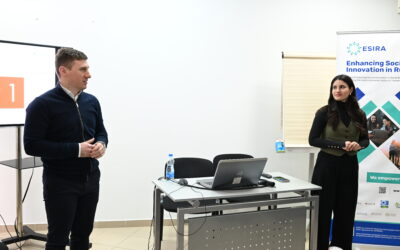
An initiative aimed at strengthening small women-led businesses from rural areas was launched on 18 February 2026 in Leskovac. The event was organized by the Institute for Development and Innovation (IRI), together with the Center for Development of Jablanica and...

STRENGTHENING THE SOCIAL ECONOMY IN REGIONS: DRUSKININKAI RURAL AREA
On December 8–9, 2025, the Institute of Economics and Rural Development of the Lithuanian Center for Social Sciences, together with the Druskininkai Local Action Group, organized a two-day ESIRA project working meeting. The event brought together representatives of...

ESIRA PROJECT HELD SCIENTIFIC DISSEMINATION WORKSHOP AND COMMUNITY OF PRACTICE SESSION ON RURAL INNOVATION
The ESIRA project successfully organized its final Scientific Dissemination Workshop for this year, titled “From Collaboration to Action: How Multi-Actor Platforms Shape Rural Innovation”, followed by a Community of Practice (CoP) session entitled “Lessons Learned and...

ESIRA AND SERIGO CALL FOR A MORE HOLISTIC VISION TO RURAL POLICY PLANNING
20 November 2025. ESIRA and SERIGO projects organised a joint policy workshop held on 20 November 2025 in Brussels, to explore how community-led social innovation can enhance the social inclusion of vulnerable groups in rural areas. Co-organised by the European...

SAVE THE DATE AND CALL FOR PARTICIPATION: ESIRA Scientific Dissemination Workshop and CoP Session
The ESIRA project is pleased to announce the upcoming Scientific Dissemination Workshop & Community of Practice (CoP) Session, taking place on 17 December 2025 at 10:00 CET, online on MS Teams. Under the title “From Collaboration to Action: How Multi-Actor...

RURAL INNOVATION TAKES CENTRE STAGE AT 10TH EMES CONFERENCE WITH A PANEL ON RURAL SOCIAL ECONOMY
A team of researchers from the ESIRA and SERIGO Horizon Europe projects presented their findings at the 10th EMES conference. Coordinated by Luca Koltai (HÉTFA Research Institute), the panel featured contributions from scholars at the University of Burgos, Euricse,...

THE FOURTH GENERAL ASSEMBLY WAS HELAD IN POLAND
The fourth General Assembly of the ESIRA project (Enhancing Social Inclusion and Rural Areas) took place from October 15 to 17, 2025, in Orelec, in the Bieszczady Mountains, Poland. The event was hosted by the local partner, the European Rural Development Network...

ACCESSIBLE CINEMA EVENT IN CILLERUELO DE ABAJO PROMOTES SOCIAL INCLUSION IN RURAL AREAS
Last weekend, the village of Cilleruelo de Abajo, in the province of Burgos, held a very special event dedicated to accessible cinema. The initiative was organized by the Collalba Cultural Association, in collaboration with ARANSBUR (Association of Families of Deaf...

EL HUECO AND EL COLLETERO SHOWCASES FOR RURAL SOCIAL INNOVATION UNDER ESIRA PROJECT
As part of the training activities carried out by the European ESIRA Project, focused on promoting social innovation in rural areas, on Friday, September 12, nearly 50 rural development practitioners took part in an intensive workday aimed at identifying and learning...

THIRD GENERAL ASSEMBLY OF THE ESIRA PROJECT HELD IN NORWAY
The third General Assembly of the ESIRA project (Enhancing Social Inclusion and Rural Areas) took place from May 20 to 22, 2025, in the Norwegian town of Kongsvinger. The event was hosted by local partners the Inland Norway University of Applied Sciences (INN), and...